
Middletown City Directory Holdings
Middletown has three useful directory paths: official scans on the city's directory page, shelf and microfilm help through Russell Library, and the broader Wesleyan collection. Together they cover more ground than any one browse page, but the years do not form an uninterrupted annual run. The table keeps the collections separate so a citation can show both the year and the place where the page was read.
| Collection | Years | Where Held | Access |
|---|---|---|---|
| City-hosted Middletown directory scans | 1875; 1884-1886; 1900-1910; 1915; 1919; 1925; 1930; 1935; 1941; 1945; 1950; 1960; 1965; 1970; 1975; 1978; 1981; 1990 | Middletown official directory page | Public PDF scans |
| Russell Library Middletown Room | 1871-1990, with gaps | 123 Broad Street, Middletown Room | Appointment and reference help |
| Wesleyan directory collection | 1868-1927 Special Collections; 1928-1980 stacks | Olin Library and Special Collections, 252 Church Street | Research access; call ahead for the collection route |
| Press and Penny Press indexes | Title-specific local runs | Russell Library and Connecticut Digital Archive | Index leads, with article access varying by item |
| Yearbooks and companion local records | Middletown and Wilson 1908-present, with gaps; deeds and maps also held locally | Russell Library, historical society, and university collections | Reference, shelf, microfilm, or appointment routes |
The official scan list is a browse set, not proof that a missing year was never printed. Wesleyan's local-history account identifies Price & Lee Co., New Haven, for the 1904-1910 run, while the Beman Triangle citations reach from 1868 through 1929. Read the title page of the actual volume when a publisher or imprint matters.
The official Middletown directory collection page shows how the digitized route is organized by year. It is the right first stop for a quick scan, while Russell or Wesleyan can supply context when a page is missing or an abbreviation is hard to read.
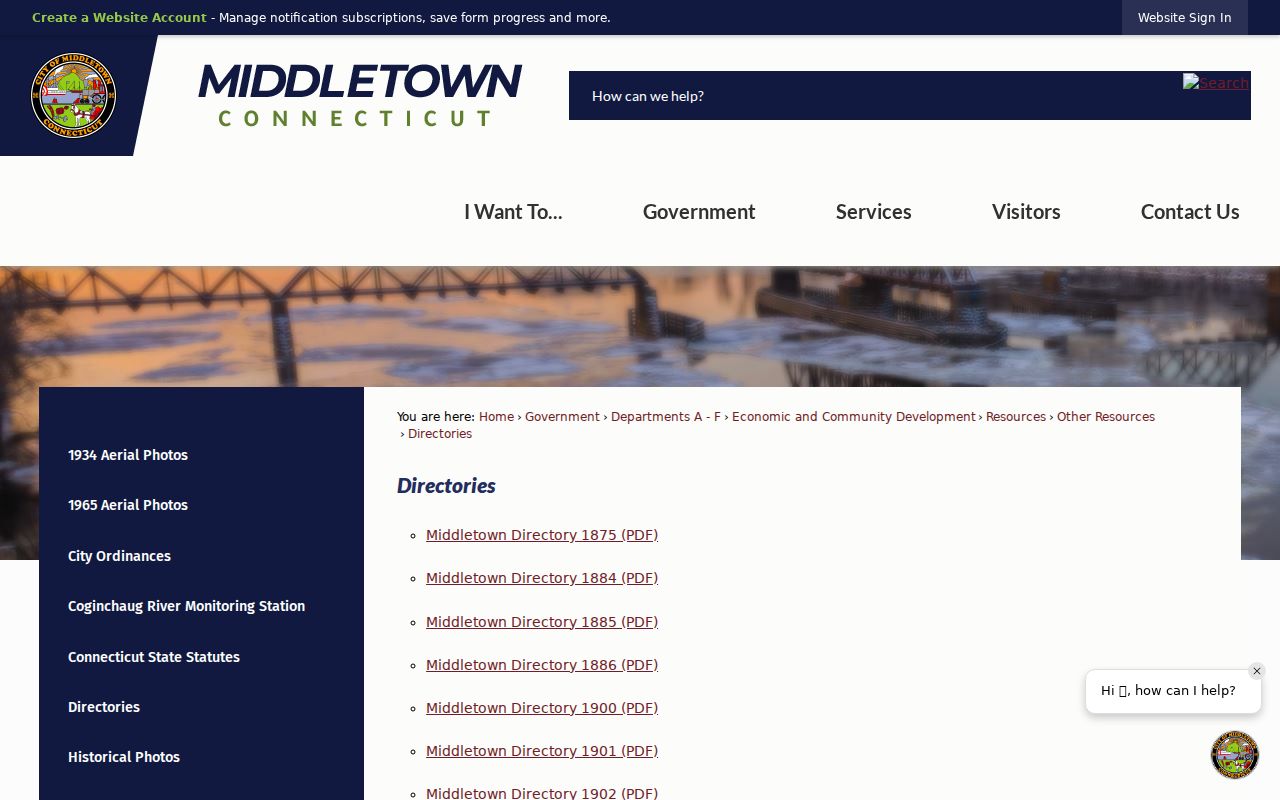
This source image belongs to the official collection page and helps distinguish a city-hosted scan from a library shelf holding. Keep the source URL, volume year, page number, and scan location together in your notes.
A Gapped Middletown Directory Timeline
The history of Middletown's printed directories is layered. An early Price & Lee-linked trace appears in Wesleyan's local research, the official scan page begins later, and the university shelves extend through years that are not all represented in the public PDFs. This short timeline shows why a researcher should search more than one repository.
- 1868. Wesleyan's Beman research cites an early Middletown City Directory source, giving the historical trail a starting point before the city scan series.
- 1875. The official Middletown page begins its listed scan run with a 48-page directory.
- 1884-1886. Official scans add an early group of year volumes, useful for comparing names, addresses, and title-page conventions.
- 1900-1910. The city page lists each year, and Wesleyan identifies Price & Lee for the 1904-1910 local run.
- 1928-1980 and 1990. Wesleyan places 1928-1980 in stacks, while the official scan list includes later selected years through 1990, with gaps.
There is no sound reason to fill an absent year with a guess. A missing scan may be a repository gap, a title change, a publication break, or an item that has not been digitized. Compare the nearest available volume on each side and record the source that supplied each page.
Russell Library's Middletown Directory Room
The Russell Library local-history service is the practical bridge when an online city directory scan stops short. The Middletown Room at 123 Broad Street can help locate a directory year, newspaper reel, obituary index, map, census item, or deed microfilm. The library asks researchers to make an appointment for reference support, and its local-history phone is 860-347-2528.
Russell describes directories from 1871 through 1990 with gaps. It also holds newspapers from the Middlesex Gazette, Constitution, Middletown Tribune, Penny Press, and Middletown Press, with the Middletown Press continuing from June 2, 1919. The Middletown and Wilson yearbooks run from 1908 to the present with gaps. Deeds on microfilm reach 1654-1907, and an early grantor-grantee and vital index covers 1654-1855. Maps, atlases, cemetery material, genealogies, and census microfilm let a directory entry be checked against a second record.
Ask for a collection-specific search. Give the librarian a surname, approximate year, street or address, and the kind of answer needed. A reference appointment can identify a reel or volume even when a broad web search returns no useful hit.
Wesleyan Middletown Directory Shelves
Wesleyan adds a distinct university route to the local directory collections. Its local-history description identifies Middletown directories from 1868-1927 in Special Collections and 1928-1980 in the library stacks. The same source explains that the volumes contain alphabetic names, reverse or street sections, advertisements, associations, and Price & Lee maps from 1888-1927. Olin Library is at 252 Church Street, and the listed phone is 860-685-3864.
The university archive also holds Middletown Press research files from about 1920-1985, described as open for research. Those files can preserve named people, events, and local context that a directory index alone cannot explain. Use the Wesleyan local-history description for the directory route and the Press research-file series when the newspaper trail is the stronger lead.
The linked Wesleyan source shows why a city directory is more than an alphabetic name list. Its reverse pages can turn an old number into a name, while the alphabetic pages add the occupation, relationship, organization, or alternate address needed to test that name elsewhere.
This image is linked to the Wesleyan source that describes the holdings. Preserve the collection name and repository in a citation, because a shelf volume and a city PDF are not interchangeable copies.
Read a Middletown City Directory Entry
A useful entry reading starts with the page's key, not with a modern assumption about a name. Older Middletown city directories may use initials, shortened street names, relationship notes, and marks whose meaning is explained in the introduction. Read the alphabetic page and the reverse section together, then copy the page number and the exact spelling.
| Name | Person or institution as printed, sometimes followed by a spouse or household relationship. |
|---|---|
| Occupation or trade | The stated work, trade, school, church, club, or business affiliation, when the volume includes it. |
| Address | House number and street, with a separate business address when the entry gives both. |
| Ownership or occupancy mark | A title-specific mark, including owner, renter, or widow notation where that volume uses one. |
| Reverse section | Street-order pages that connect a number to an occupant, household, business, or institution for that year. |
- Criss-cross directory
- The reverse or street-order half of a directory. It starts with an address rather than a surname.
- Householder index
- A name-focused route intended to locate a household head or principal entry. It does not guarantee that every person at the address is listed.
- Abbreviation key
- The introductory explanation for short marks and symbols. Photograph or transcribe it before interpreting a one-letter note.
Institutional entries can work differently from household entries. A church, school, club, or business may name a pastor, trustee, officer, or contact without giving a private home address. That is still a useful year and page anchor, but it should be described as an institutional record.
Cross Street AME Zion's Middletown Directory Trail
The Wesleyan Beman Triangle project gives the Middletown city directory method a precise local example. Its Cross Street African Methodist Episcopal Zion Church source names pastors, service years, and the exact directory pages cited in its footnotes. Those citations can lead a researcher from a community history to a scan or shelf volume without inventing a street address for a named pastor.
- Allen Walker, 1872-1873, directory page 131.
- W. D. F. Pyle, 1874, directory page 111.
- G. H. S. Bell, 1888-1889, directory pages 164-165.
- S. E. Robinson, 1900, directory page 200.
- Moses Monzino, 1904-1905, directory page 230.
- William J. Smith, 1908-1910, directory pages 218, 226, and 238.
The same project records trustees, Sunday School officers, a preacher's steward, secretary, treasurer, and sexton for selected years. These named roles can be compared with newspapers, church records, census entries, and vital records. The source gives exact years and pages, but it does not provide a verified street address for these pastors. Keep the evidence tied to the church role and cited directory page.
Use Middletown City Directories for Family History
For a household trail, treat each directory as one dated observation. Start with the best address and year you have, then let the reverse section find the printed name. The alphabetic section may add a spouse, occupation, relationship, affiliation, or alternate address. A later census or newspaper can test whether the same name stayed in the same place.
- Set the starting point. Write the name, address, approximate year, street spelling, and any map-lot or deed clue before opening a volume.
- Read by address. Find the street section and copy every relevant entry at that number, including initials and marks.
- Read by name. Use the alphabetic pages to capture relationship, trade, organization, and alternate address details.
- Compare another year. A second volume two to five years away can show a move, new household member, changed spelling, or a temporary listing.
- Pair a census. Russell's local route includes 1870, 1880, 1900, 1910, 1920, and 1930 material; the federal 1890 schedule is missing.
- Close the gap. Follow a disappearance into a newspaper or obituary index, deed, probate file, cemetery source, or vital-record route rather than guessing what happened.
Newspaper titles matter. A search for the Middletown Tribune is not the same as a search for the Penny Press or the Middletown Press. Normalize initials, spelling, and street abbreviations, and record the page or index item that supports each conclusion. When the question shifts to a current parcel, the Middletown by-street workflow supplies the modern GIS, Vision, and land-record bridge.
Middletown Directory Name Index Beyond
A directory gap can sometimes be checked with a separate name index. The free Connecticut Genealogy Index covers state-filed birth, marriage, civil-union, and death material and offers given-name and surname searching, soundalike or exact modes, date controls, radius, county, and town filters. It is not a Middletown city directory and it is not a complete current resident list. Its value is as a dated corroboration route when a directory name appears, disappears, or changes form.
The linked search page illustrates the companion-record role. Use the directory for address and trade context, then use the index to test whether a vital event could explain a change in the household trail.
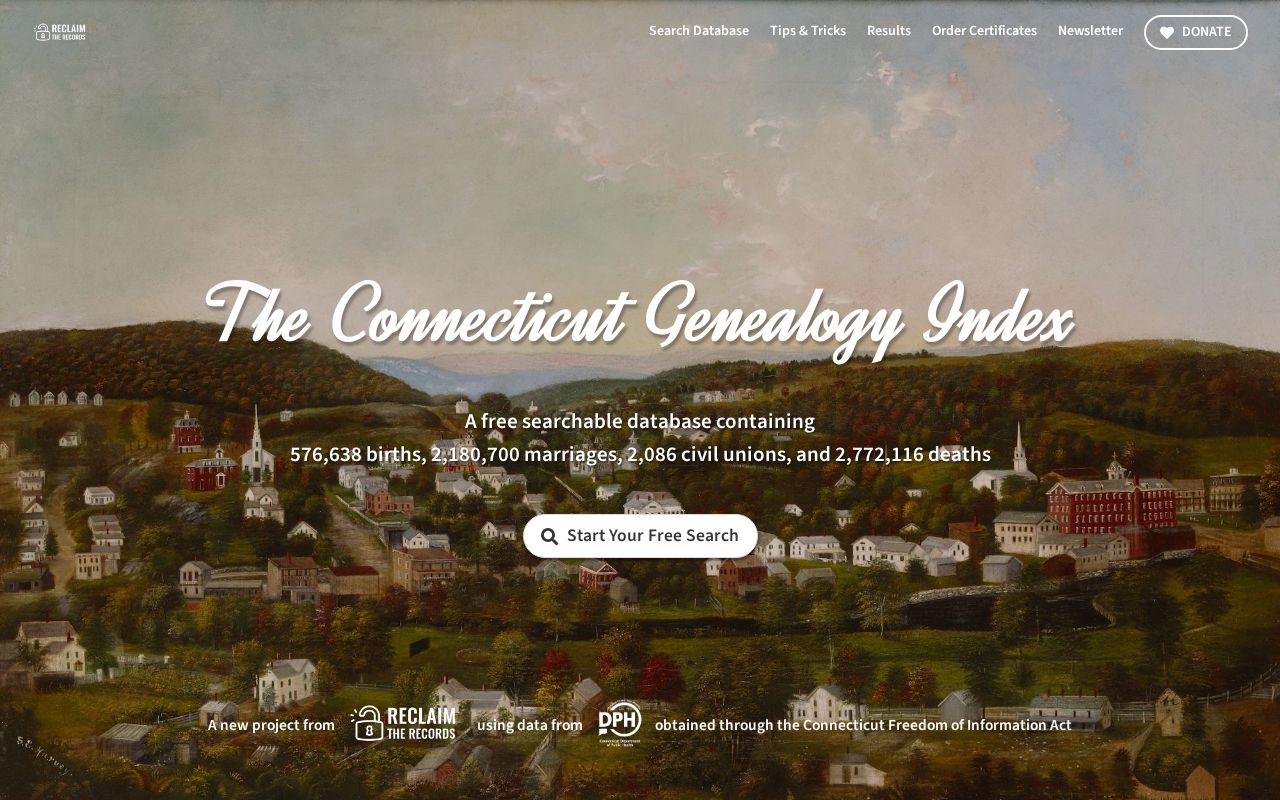
This image is tied to the index source, not presented as a directory scan. Keeping that distinction in the caption and notes prevents a vital-record index from being mistaken for proof of residence.
Middletown Directory Gaps Need Context
Missing years are common in this collection map. A name may be absent because the volume is missing, the publisher changed its coverage, the person was temporarily unlisted, initials or spelling shifted, or the entry moved into an institutional or business section. Use the nearest available years and look for a second record before treating absence as a move or death.
The Middlesex County Historical Society adds town records, tax lists, court material, census, naturalization, family papers, church records, and cemetery sources. Its research service is by appointment at 151 Main Street, phone 860-346-0746. The published access terms list members as free, nonmembers at $10 per day, copies at $0.25 per page, and remote research at $40 per hour plus a $20 initial assessment, with up to eight weeks stated for remote work.
Research habit. Save the repository, volume year, page, exact name, street spelling, and the reason a second source was chosen. That record keeps a city directory clue separate from a confirmed life event.
Russell, Wesleyan, city scans, MCHS, newspapers, yearbooks, census, deeds, and the state index each preserve a different slice. A strong Middletown city directory citation names the slice instead of implying that one old volume answers every question about a person or address.