
Middletown Previous Residents by Era
A house history is a stack of records, not one continuous resident list. Start with the current property card, use the land index for recorded transfers, and then change source when the question changes from ownership to occupancy. The table below keeps those tasks separate. It also shows why a search for previous residents can continue even when an online screen has no older result.
| Source | Years It Covers | Where Held | What It Shows |
|---|---|---|---|
| Vision assessment card | Current card; historical start not stated | Middletown Assessor and Vision | Owner of record, situs and mailing fields, PID, map-lot, account, building and sale-history leads |
| RecordHub land index and images | January 1, 1969 to present | Town Clerk and RecordHub | Grantors, grantees, instruments, dates, book/page, descriptions and image access |
| Deed books and early index | 1654 to 1907; early index 1654 to 1855 | Town Clerk and Russell Library microfilm | Earlier recorded ownership names and deed references |
| City directory scans | 1875; 1884 to 1886; 1900 to 1910; selected years to 1990 | Middletown city scans | Alphabetic names and reverse address entries, with gaps between runs |
| Wesleyan and Russell directories | 1868 to 1927; 1928 to 1980; Russell 1871 to 1990 with gaps | Wesleyan collections and Russell Middletown Room | Address, occupation, household, business, association and advertisement clues |
| Federal census | 1790 to 1930, except the lost 1890 schedule | Russell Library and federal archive routes | Household members, age, birthplace, relationship, occupation and enumeration geography |
| Sanborn maps | 1884, 1889, 1895, 1901, 1907, 1913 and 1924 | City reports, Russell Library and the Library of Congress | Building footprint, use, material, stories and surrounding lot context |
| Newspapers and probate | Newspaper titles from 1790 to present; probate coverage varies | Russell Library, MCHS and Middletown Probate Court | Moves, deaths, notices, estates, heirs and community connections |
| Building permits | Archive start not published | Middletown Building Division | Project address, map, lot, PID, work scope and inspection or certificate clues |
Choose the row that fits the question. A deed can show that a person conveyed a parcel, while a reverse directory can show that a named household appeared at the address. A census can add family structure for a single enumeration year. A permit can date work without proving that the applicant lived there. The strongest account places two or more records beside the same legal description, street number, or year.
A Middletown Parcel for Past Residents
The current starting point is the Vision card for the Middletown Municipal Building, a safe demonstration record rather than a private household. Its location is 245 deKoven Drive. The card identifies PID 46, shows a map-lot formatted as 22, 0586, and lists account E30087. It names the City of Middletown as owner of record and shows the same deKoven address in the owner address field. Those are useful examples of the fields to copy from any parcel card.
For a private address, record the current situs or location, owner name, owner mailing address, PID, account, map-lot, legal-description lead, valuation and building fields. Then look for the card's sales or ownership-history columns, including book and page when present. Do not treat every visible row as a normal transfer. The municipal sample has a zero-price, 0000/0000 book-and-page row dated January 1, 1990, which the research identifies as a municipal placeholder. It is a good warning that a displayed history line needs context.
The Vision screen is a current assessment and building source. It is not proof that the owner occupies the parcel, and it is not a substitute for the Town Clerk's recorded deed. Keep the card's property identity with the later deed search, because the legal description and map-lot can remain useful when a street number changes.
The RecordHub search-site selection shows the entry point for the next part of the trail.
The image is a portal-selection view, so it helps distinguish the vendor doorway from the City of Middletown's custodian. Use the Town Clerk when a record needs official confirmation.
Middletown Deed Chain, Backward
Connecticut has no active county recorder layer for this search. Middletown is the Middlesex County seat, but the functional local recorder is the Middletown Town Clerk. The city states that the online land index and images run from January 1, 1969 to present. Start with the current owner as a likely grantee, then work back one conveyance at a time. That deed chain can support previous residents only when a directory or census connects a person to the address.
- Copy the current card's owner, situs address, PID, map-lot, account, mailing address and any legal-description or book-and-page lead.
- Search the owner in RecordHub as a grantee. Narrow the date range and document type when the portal permits it, and compare the legal description with the parcel identity.
- Open the purchase instrument or image and record the grantor, grantee, instrument kind, file date, document number, book/page, amount and description.
- Search the prior grantor as a grantee in an earlier range. Repeat under alternate spellings, initials, entity suffixes, estate names or spouse combinations when the index suggests them.
- Continue to the January 1, 1969 boundary. For earlier deeds, move to the Town Clerk books or Russell Library microfilm instead of assuming the web search is a complete history.
- Use directories, census pages, newspapers, probate and permits separately when the goal is to identify people who lived at the property rather than people who held title.
- Grantor
- The party transferring an interest in the recorded instrument.
- Grantee
- The party receiving the interest. A past grantee may become a later grantor.
- Chain of title
- The linked sequence of recorded transfers that connects a present title record to earlier parties.
- Legal description
- The map-lot, lot or block, or metes-and-bounds description that identifies land more reliably than an old street label.
Past Owners in the Middletown Land Index
RecordHub offers two different access experiences for Middletown land records. The city describes an index and image range beginning January 1, 1969. The vendor's site-selection and product information show a guest or no-subscription route for index work, while images may be pay-to-print or part of a subscription product. A free index result is not the same as a free document image or a certified copy.
The search labels support a practical backward search. Simple Search, Expanded Search and Name Directory are separate modes. Expanded Search can use Begins With or Contains, a date range and document or index type choices. Name Directory can return name spellings and document counts before a researcher opens a result. Indexed result fields include party roles, instrument kind, file date, property description, document number, book/page, reference, amount and an image indicator.
| RecordHub control | How it helps address history |
|---|---|
| Party or name | Search the current grantee, then the prior grantor as an earlier grantee. |
| Begins With or Contains | Test spelling, initials and entity forms without treating a partial match as proof. |
| Date range | Limit the likely purchase or predecessor period before opening a crowded result set. |
| Index or document type | Separate deeds, mortgages, releases, liens and other recorded instruments where the local options allow. |
| Book/page and legal description | Carry a stable land reference into the next search and into an older clerk or library request. |
When an image is gated, use the guest index as a lead, then contact the Town Clerk at 245 deKoven Drive or 860-638-4910 for a counter, copy or written-request route. The city does not publish one simple deed-copy price on the land-record landing page, so an exact amount should be confirmed with the custodian.
The Middletown RecordHub date screen shows the coverage-oriented side of the service.
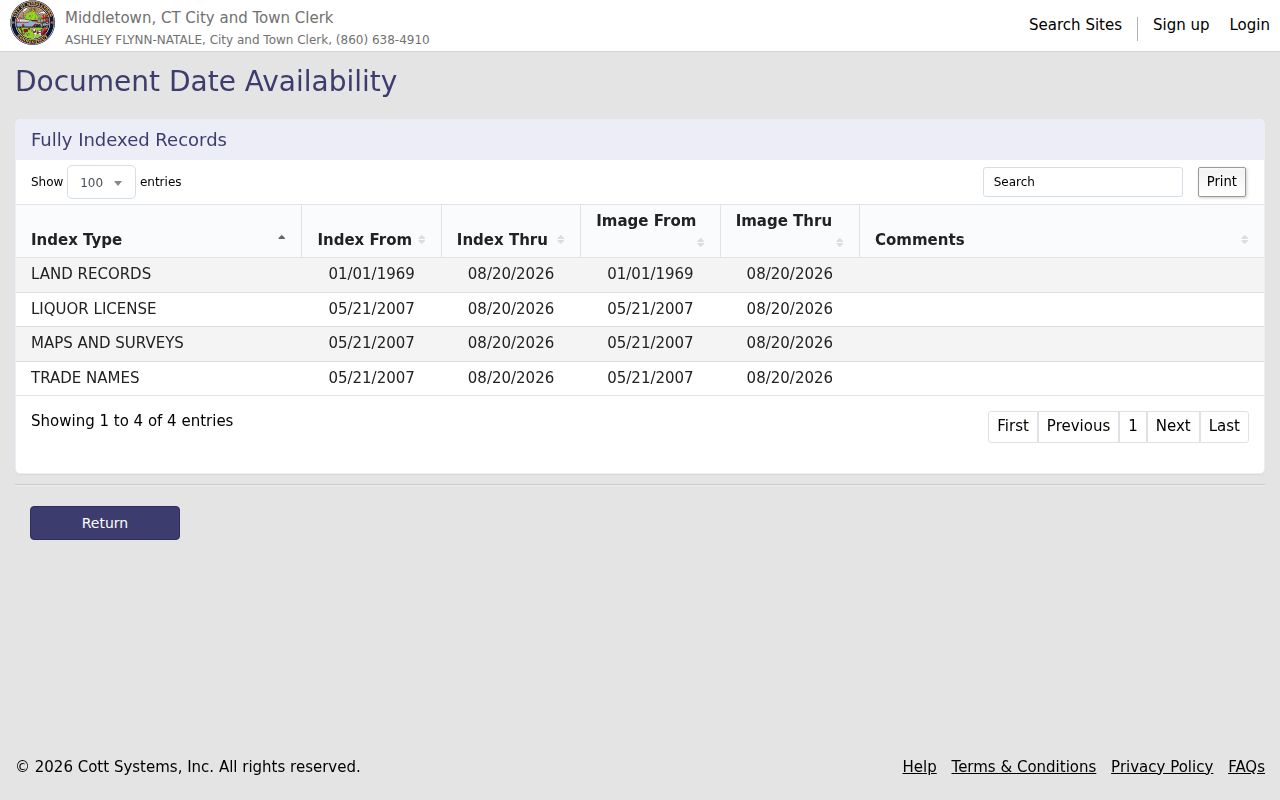
This image is a date-coverage reference, not a deed for a particular house. It reinforces the need to label an index lead, an image, and a certified Town Clerk copy as different things.
Middletown’s Earlier Deed Shelf
For pre-1969 ownership, Russell Library is the local bridge. Its Middletown Room at 123 Broad Street reports deeds from 1654 to 1907 on microfilm and an early grantor-grantee and vital index from 1654 to 1855. The library asks researchers to make an appointment. Call 860-347-2528 and request the deed books, index years or reel material that match the parcel's name and legal description.
The Middlesex County Historical Society at 151 Main Street is a second local channel for selected town records, tax lists, court records, naturalization material, family papers and church or cemetery holdings. Its research page lists appointment access, a $10 daily fee for nonmembers, copies at $0.25 per page, and remote research at $40 per hour plus a $20 initial assessment, with a possible eight-week turnaround. These are repository terms, not a blanket charge for every Town Clerk request.
Bring a compact request: current or historic street label, approximate year, owner or grantor name, map-lot or PID, and any deed book/page lead. Ask whether the requested item is an index, a microfilm image, a transcription or a certified town record. The custody path matters because an early index can point to a book without answering every question about the parcel.
Middletown Past Households in Directories
Recorded owners are only one part of previous-resident research. The city scan run includes 1875, 1884 to 1886, 1900 to 1910, 1915, 1919, 1925, 1930, 1935, 1941, 1945, 1950, 1960, 1965, 1970, 1975, 1978, 1981 and 1990, with gaps. Russell reports directories from 1871 to 1990 with gaps. Wesleyan identifies local directories from 1868 to 1927 in Special Collections and 1928 to 1980 in the stacks. The collection descriptions and shelf details are gathered on the Middletown city directories page.
For one address, read the reverse or street section first. Copy the street spelling, number, occupant or business entry, initials, relationship notation and any abbreviation key. Then find the same name in the alphabetic section and note occupation, spouse or household clues, ownership or occupancy marks where the volume uses them, and a separate business address. A reverse entry can represent a head of household, a boarding arrangement, a business or an institution. It is a historical lead, not a complete list of everyone present.
- Choose the closest available directory year and write down the printed street form before changing it to the modern form.
- Read the reverse address entry, then verify the name in the alphabetic section and copy the page number.
- Compare the next available year and the closest census year, keeping initials and alternate spellings in the notes.
- Use a newspaper, probate file, deed or permit to test a move, death, estate transfer or building change.
That directory-to-census flow is especially important where the annual run has gaps. Missing a printed year does not show that an address was empty.
Middletown Households and Census Checks
Russell's local census list covers Middletown schedules from 1790 through 1880 and from 1900 through 1930. The 1890 federal schedule was lost nationally, so no local directory search can supply that missing census year. Census pages add household composition, age, birthplace, relationship, occupation and enumeration district. They can also show why an old address is hard to match when a road was rural, a number was not printed, or the enumerator used a different description.
Match a census entry to an address with more than a surname. Use the street or district, age range, occupation, spouse or parent relationship, and a directory year on either side. A deed can then test the parcel identity, while a newspaper or probate notice can explain a death or move. Keep the evidence labels clear: census household, directory occupant, deed party and assessment owner are different claims about the same place.
Russell's newspaper microfilm gives another local route, from the Middlesex Gazette in 1790 to the Middletown Press from June 2, 1919 to present, with several title changes in between. The library's digitized Penny Press and Middletown Press indexes can locate a notice, but an obituary is a lead rather than a death certificate.
Middletown Sanborn Maps and Permit Clues
Sanborn maps help date the structure rather than identify every person who lived in it. Middletown material lists sheets for 1884, 1889, 1895, 1901, 1907, 1913 and 1924. The Library of Congress collection includes a digitized 1907 Middletown set with 32 sheets. On a sheet, compare the map index, street name, footprint, story count, construction material, use and nearby lots. Downtown-focused coverage may not reach every outlying parcel.
The Library of Congress Middletown Sanborn collection can help bridge an old street label or number to a building footprint. Pair that map with the deed's legal description, a Price and Lee map, a reverse directory and the current parcel card. The result is a dated structure and address trail, not a claim that a named person occupied every building shown.
The Middletown Building Division application route uses Project Address, Map, Lot, Parcel ID, Zone and Lot Area. A written or counter request can ask about the permit or application number, applicant or owner, scope, inspection or certificate dates, fee and disposition. The archive start date is not published in the cited source. A permit can show work, additions or a use change, but it is not automatically a title transfer.
Newspapers for Middletown Previous Residents
Newspapers and probate often close a human trail that deeds leave open. Start with a directory name, address, church or business, then search the Russell indexes and title-specific microfilm for a death notice, move, legal notice or community event. The notice can point to a date and relationship. Follow it to Middletown Vital Statistics, a cemetery record or a probate file rather than treating the clipping as a certified fact.
The Middletown Probate Court at 94 Court Street covers estates and related filings for Middletown and nearby towns. Its online case lookup is a separate state court system, and the research does not state a complete historical coverage range. Older files and copies go through the clerk. A probate record may identify a fiduciary, heirs or an estate address. It does not by itself prove that every heir lived at the house.
For a request that is not searchable online, the city also launched JustFOIA for electronic public-record requests and status tracking. It is a request intake system, not proof that every historic record has been digitized. Name the office, year, address, map-lot or PID, and the narrow record type in the request.
Middletown Address Changes and House History
No verified Middletown street-renumbering or street-renaming history was located in the research. Do not assign a year to a supposed change from one street number to another. Instead, bridge the records with the legal description, map-lot, PID, adjacent intersection, Sanborn sheet, Price and Lee map and the old directory spelling. Search both forms, then ask the custodian to confirm the match.
Middletown Engineering handles house numbers, street names and mapping. The office is at 245 deKoven Drive, phone 860-638-4862, with hours listed as 8:30 to 4:30. Streets can also be state, private, paved or unpaved roads, so define which road layer or historical source was used. A current address result does not erase an older legal identity.
When a bridge remains uncertain, describe the result as an address lead. A later deed, clerk confirmation or parcel comparison can upgrade it to a documented link. This careful wording prevents a plausible map match from becoming an unsupported list of previous residents. It keeps previous residents research tied to evidence rather than inference.
Lawful Middletown Previous-Resident Research
House history and family history are legitimate reasons to examine public records. So are checking a recorded transfer, reconnecting with a former classmate through an appropriate public source, or understanding how a building changed. The record trail should stop when the goal becomes tracking a living person, publishing a private contact detail or using an old address to intimidate someone.
Use records with care. Middletown ownership, directory and census sources are incomplete and can be wrong or out of date. Confirm important facts with the Town Clerk, Assessor, library or court that holds the record. Do not use previous-resident research to stalk, harass or harm anyone. Connecticut stalking and harassment rules apply even when a source is publicly accessible.
When a record appears wrong, preserve the source URL, PID, book/page or page citation and contact the originating custodian. The Assessor handles card questions, the Town Clerk handles land-record questions, and Russell or the Historical Society can explain a historical index. That chain of responsibility is the safest way to correct a past-resident conclusion.