
What Middletown Resident Records Confirm
Different custodians answer different parts of a person search. The City Assessor and GIS layer connect a name to a parcel or mailing address, but an owner is not automatically an occupant. The land index adds recorded parties and legal descriptions. MyVote is a one-person status and polling-place route, while the Superior Court system supplies a public case index. Vital, probate, business, license, directory, and yearbook sources become useful when the goal is a family event, an heir lead, a former name, a classmate, or a historical household.
| Record | What It Can Confirm | Official Route | Access and Limit |
|---|---|---|---|
| Assessor / Vision card | Owner of record, owner mailing address, parcel situs, building and valuation clues | Vision Property Lookup | Current assessment record, not a complete occupant roll |
| City GIS | Parcel geometry, map-lot, PID, situs and mailing fields, nearby parcels | Middletown GIS Application | Published current layer; no public ZIP search box was located |
| Land records | Deed parties, legal description, recording date, book and page, instrument chain | RecordHub and the Town Clerk | Online index and images run from January 1, 1969 to present; images may be gated |
| Voter lookup | Status, party, polling place or district, and public birth year where shown | MyVote and Middletown Registrars | One-person route; the full CSV file costs $300 and has statutory purpose limits |
| Superior Court | Party name, docket, case type, dates, appearances, and disposition | Connecticut party search | Public display is not the full case file; protected records are absent |
| Probate | Estate, fiduciary, will, inventory, and possible heir leads | Middletown Probate Court | Copies and older material go through the court clerk |
| Vital records | Birth, death, marriage, civil union, and relationship events | Middletown Vital Statistics and DPH | Birth records are confidential for 100 years; certificates need the proper form and proof |
| Business filing | Entity name, ALEI, principal, agent, formation date, and business address | Connecticut Secretary of the State | An entity or agent address is not proof of personal residence |
| Professional license | Credential type, number, status, dates, scope, and public address fields | Connecticut eLicense | Shows a credential affiliation, not necessarily a home address |
| Directories and yearbooks | Historic address, household, occupation, class, obituary, or community link | Russell, Wesleyan, and local collections | Year runs have gaps; an index lead needs the original or scan |
Choose the least intrusive source that can answer the question. An address clue points toward Vision, GIS, and the deed index. A former surname points toward a court result, marriage index, directory, or probate file. A school year and club can be stronger than a common name. The Middletown RecordHub index is the land-record bridge when a parcel name needs a recorded deed. The result should be a documented match with a source date, not a pile of unconnected names.
Verify a Middletown Resident
Use a name, place, and time together. Before searching, write down the spelling you were given, middle initial, former name, approximate age or year, street, institution clue, or family connection. The phrase “same name” is not a match. It is a prompt to find a second detail that an unrelated person is unlikely to share.
- Normalize the name. Try the exact spelling, a former name, a middle initial, and a close spelling without silently combining the results.
- Search the Vision Property Lookup by owner or address, then compare Location with Owner Address. Use the Middletown GIS Application map-lot or PID to hold the parcel steady.
- Use MyVote only for the person-level registration response the public interface returns. Do not turn a status lookup into a street list.
- Run the Connecticut Superior Court party search with the last name first. Add the first name, choose Middlesex, and test Starts With, Contains, or Sounds Like.
- Use a vital index or certificate for a specific event, such as a marriage that explains a former surname or a death that closes a historical trail.
- Check a Secretary of the State entity or eLicense credential when an affiliation is part of the question. Treat a principal, agent, or practice address as an affiliation.
- For an older resident, move to Russell directories, reverse street pages, yearbooks, newspapers, Wesleyan collections, or Middlesex County Historical Society material.
Compare age or year, middle initial, spouse or household clue, map-lot, business role, case jurisdiction, and newspaper address. If a second source conflicts, record the conflict and leave the identity unresolved. A clean “not the same person” decision is more useful than a confident merge built on a shared surname.
- Docket
- A docket is the court’s tracking number for a case. It lets the clerk and the public distinguish one proceeding from another with similar party names.
- Index versus image
- An index gives searchable fields such as a name, date, instrument, or docket. An image is a scan of the underlying page, and access may require a payment or clerk request.
- Certified copy
- A certified copy is an official reproduction marked or issued by the custodian. An index result or library scan is not a certified record.
Middletown Court Party Search Fields
The Connecticut Superior Court party search covers the Middlesex Judicial District within a statewide system. Last Name is required. First Name is optional, and the Location control can be set to Middlesex. Case Category, Case Type, and Sort Order are portal-populated controls, so their exact choices can change even though the search pattern stays familiar.
| Party Last Name | Required text field for the party-name query. |
|---|---|
| Party First Name | Optional text field that narrows a common surname. |
| Location | Select Middlesex when the question concerns the local judicial district. |
| Case Category | Portal-populated category list. The full option set is not exposed in the static page text. |
| Case Type | Portal-populated type list. Use it to narrow the kind of public proceeding when the choice is available. |
| Sort Order | Portal-populated result ordering control. |
| Name Search Type | Starts With, Contains, Is Equal To, or Sounds Like. |
| Search | Submits the party query after the required last name is entered. |
The courthouse remains the fallback when an online result is thin. The Middlesex clerk is at One Court Street. The chief clerk number is 860-343-6400, with civil at 860-343-6320, family at 860-343-6322, and criminal at 860-343-6445. Bring the party name, docket if known, and approximate year. A clerk can explain the file route, but the public display does not turn sealed, erased, juvenile, youthful-offender, or protected family material into an open result.
The court search page is the source for the live party-name form shown below.
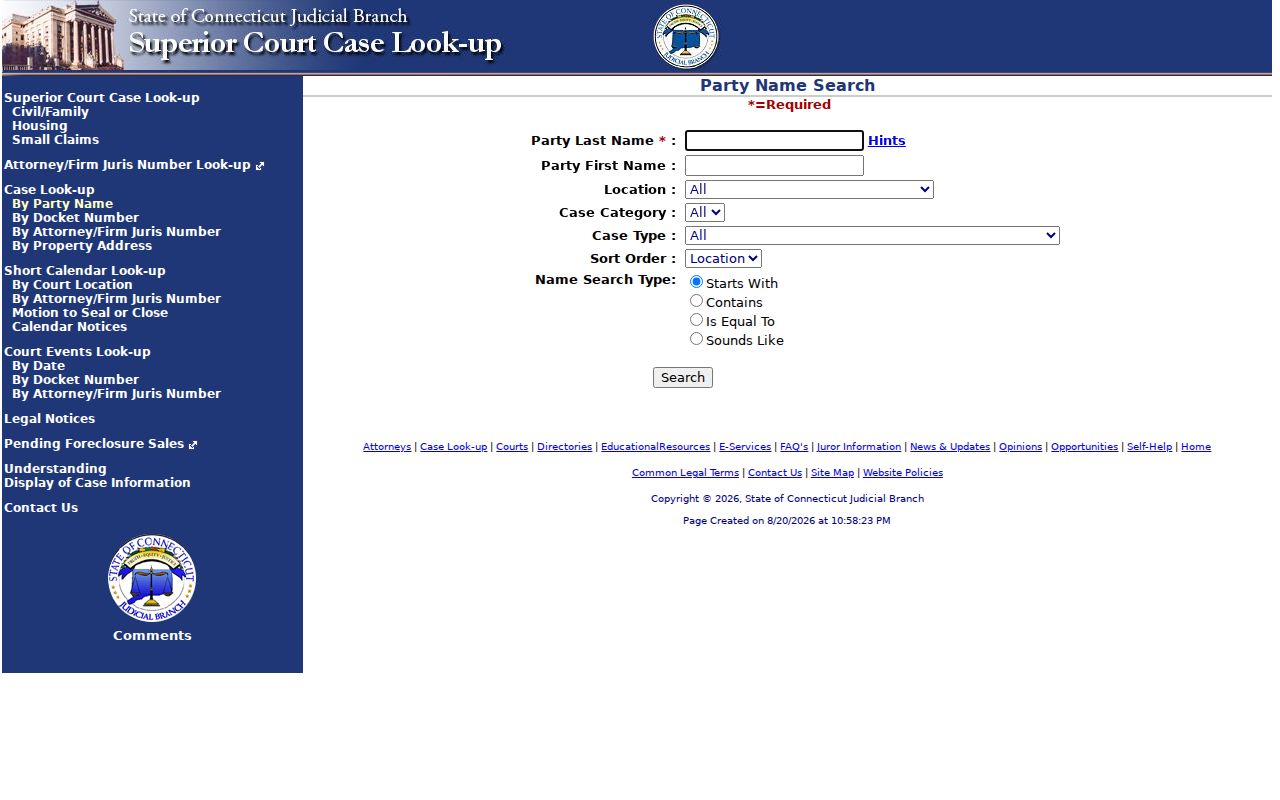
The visible controls reinforce the main identity rule: use the court index as one dated jurisdiction clue, then corroborate it with a separate Middletown record.
Read a Middletown Case Result
A returned case is an index display, not a conclusion about where a person lives. The Judicial Branch result can carry a case header, dates, parties, and appearances. A legal-notice result is another useful example: it separates the party to be notified, case name, docket number, court location, notice start date, and notice expiration date. Those fields describe a procedural publication. They do not authenticate a current address.
| Result Group | Fields That May Appear | How to Use It |
|---|---|---|
| Case header | Case name, case type, docket number, file date, return date | Separate similarly named parties and place the matter in time |
| Case information | Claim or trial-list information, disposition, disposition date, judge | Understand the public procedural status without treating it as the full record |
| Parties | Party name, role, and relationship to the case | Compare role and jurisdiction, not just surname |
| Appearances | Attorney or self-represented status, juris number, appearance date, address or phone if available | Use only as a public case-contact clue; details may be missing |
| Protected material | Sealed, erased, juvenile, adoption, youthful-offender, and protected family details may be absent | Absence is an access boundary, not proof that no event occurred |
When the index points to a file, request the underlying document from the clerk that holds it. Exact copy and certification fees for a particular Middletown case were not located in the research record, so ask before sending payment. Divorce judgments belong to the Superior Court, not DPH. Federal matters route to the District of Connecticut and probate matters follow a separate court path.
Middletown Voter Status Lookup
The Connecticut MyVote lookup is designed for one person’s registration status and polling-place answer. The Middletown Registrars of Voters, at 245 deKoven Drive in Room B15, administer the local registration record. Their number is 860-638-4950. The public record rules distinguish a public year of birth from the suppressed month and day, and they do not make every internal registrar field a public directory field.
Use the public response as a civic-status clue, not as a household roster. Party, district, polling place, active or inactive status, and participation information can help separate two people with the same name. The participation history concerns whether and how a person took part, not the person’s ballot choices. An ACP participant may have a substitute address while the actual residence stays suppressed.
The MyVote lookup route is shown here because its public function is narrower than an internal registrar search.
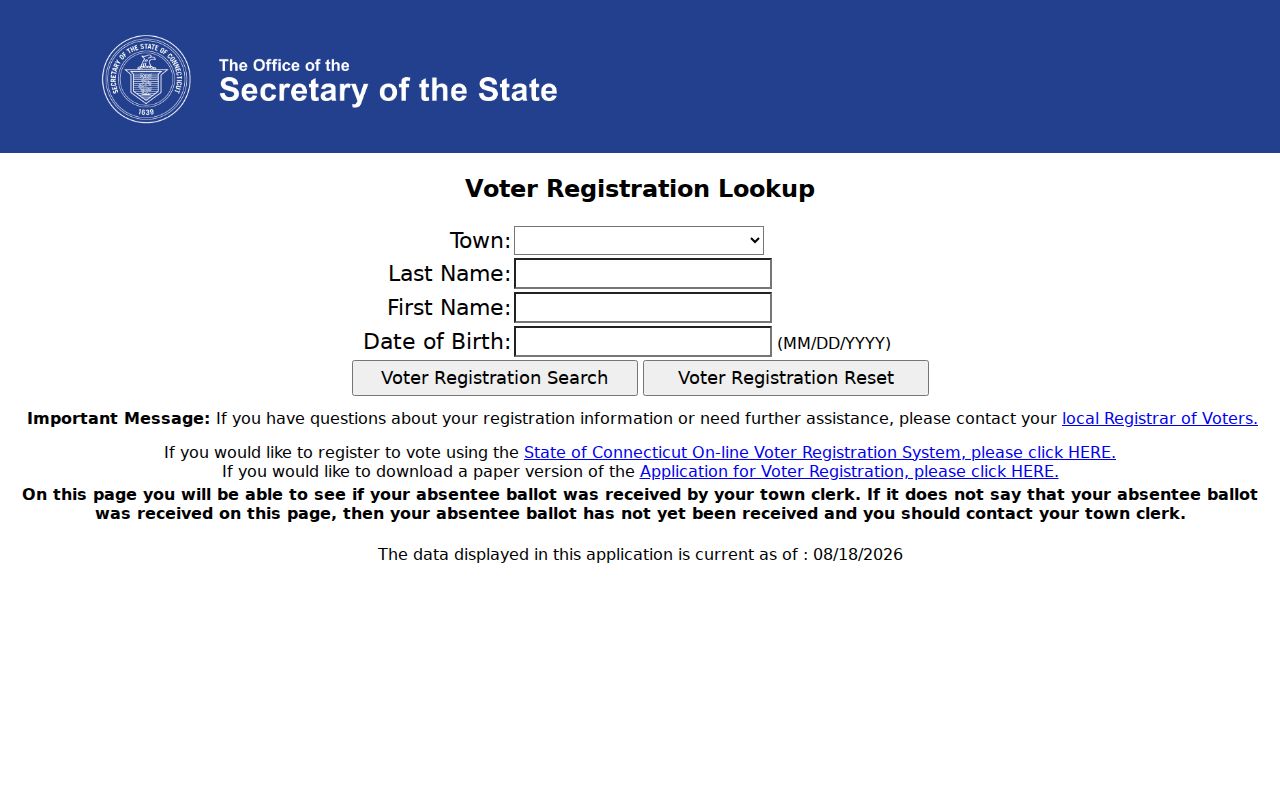
That distinction keeps a status result in its proper place in the workflow. For a correction, contact the Middletown Registrars rather than trying to infer a protected address from another source.
The Secretary of the State’s full voter file is a different route. The CSV request costs $300 and is limited to election-related, scholarly, journalistic, political, or governmental purposes. The request form also restricts personal, private, commercial, marketing, harassment, and similar reuse. A person lookup should stop at the public one-person route unless a lawful, documented purpose fits the official request procedure.
The Secretary of the State voter privacy instructions provide the full-file and public-field rules illustrated below.
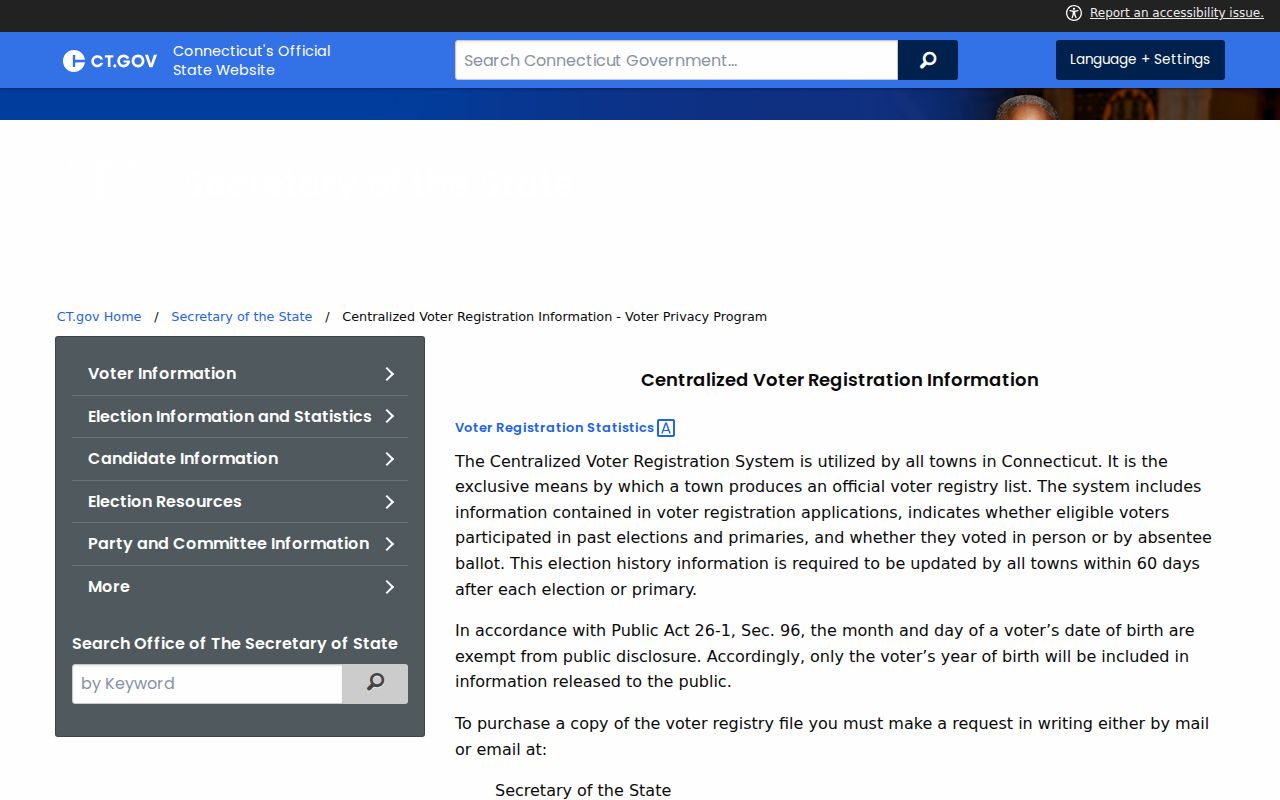
The full-file form is a regulated data request, not a shortcut to a neighborhood list or a way to republish voter information.
Middletown Vital Records and Name Clues
Middletown Vital Statistics is the practical local route for birth, death, and marriage copies. The office is at 245 deKoven Drive and can be reached at 860-638-4960. The state Office of Vital Records covers Connecticut records from July 1, 1897 to present. Local requests are often the faster route, while state processing can take up to 12 weeks under the current instructions.
Birth records are confidential for 100 years under Conn. Gen. Stat. section 7-51a. Births after January 1, 2003 can be requested from any Connecticut town or the state, subject to eligibility and proof. Older birth requests need an eligible requester and a qualifying town or state connection. The state birth copy fee is $30. Certified death and marriage copies are generally available to adults with the proper form and identification, at $20 per copy. Divorce is a court file, not a DPH vital certificate.
The Connecticut DPH applications and forms page supplies the request route represented in the resident lookup image.
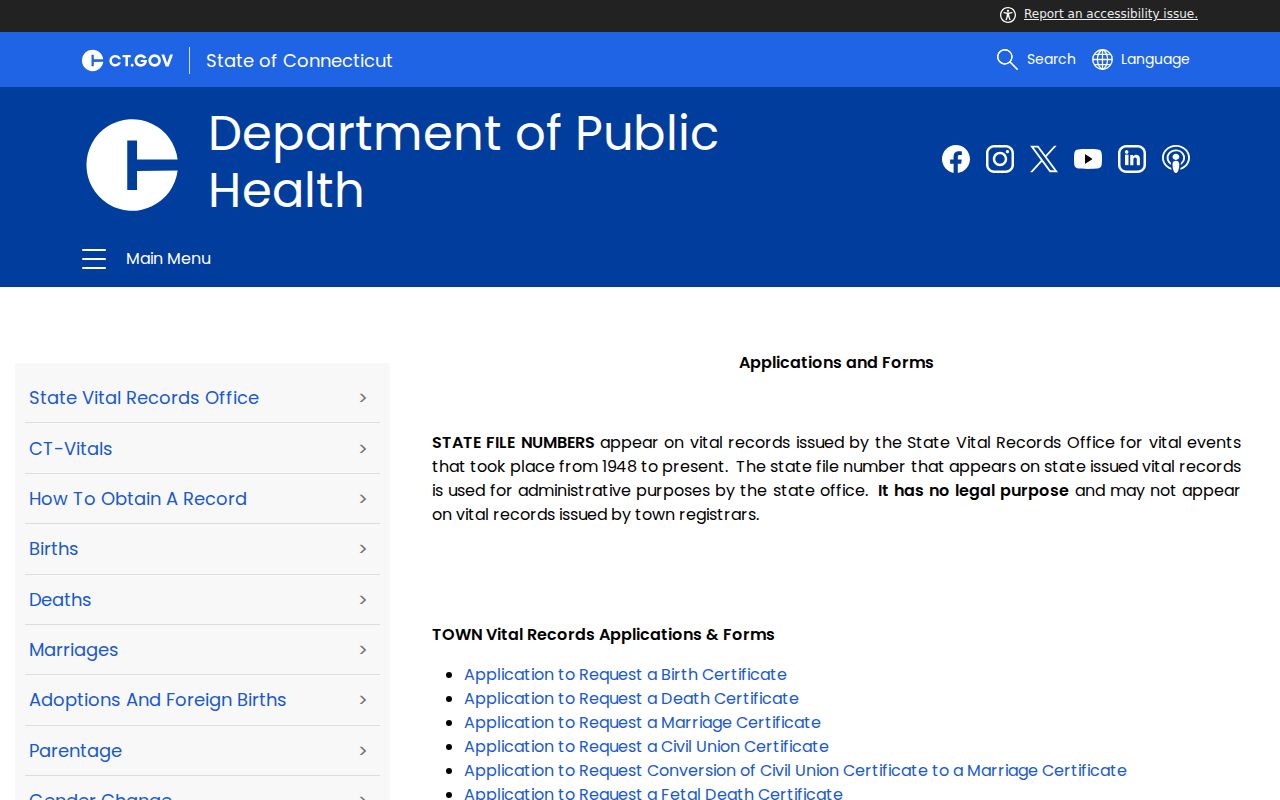
A form asks for record facts, requester identity, relationship, reason, identification, and payment. An index entry can suggest that an event exists, but it is not a certified copy and it does not remove the eligibility rules.
The free Connecticut Genealogy Index is useful for historical leads. Given name, surname, soundalike or exact matching, date range, county, town, and geographic-radius controls can surface birth, marriage, civil-union, or death entries. Its displayed birth coverage is July 1, 1897 through December 31, 1917, while marriage and death coverage runs through December 31, 2017. The index warns about missing town data, spelling variants, and older marriage entries with shortened given names. Request the certificate from the proper custodian after finding the lead.
Note: A historical vital index can identify an event, but only the responsible town or state office can explain current eligibility and issue a certified copy.
Middletown Probate Heir Records
An heir question needs a different path from a simple name search. The Middletown Probate Court serves Cromwell, Durham, Middlefield, and Middletown from 94 Court Street. Its phone is 860-347-7424, and the court page lists weekday hours of 8:30 to 4:30, a Case Lookup Tool, forms, and the clerk route for copies and older files.
Start with a current deed or a death notice when one is available. A probate case may identify a fiduciary, estate, will, inventory, or heir lead. Pair that court clue with a death certificate or obituary, then compare the person’s name and address against an earlier deed, directory, or family paper. Protected portions and court access rules control what can be copied. A probate lead can show a relationship to an estate without proving every branch of a family tree.
For a birth-parent question, use Connecticut’s official adoption and vital-record channels. Do not infer an identity from an ordinary birth index, because the 100-year rule and requester eligibility still apply. For a former classmate, a school year and class year are stronger search anchors than a common surname.
Middletown Business and License Clues
The Connecticut Secretary of the State business search at Business One Stop can be searched by business name, ALEI, or filing number. Results can show the entity name and ID, principal, registered agent, formation date, entity type, street, city, state, and ZIP. A town trade-name filing can add a local public-facing name, but an agent or principal address may be a service or business address rather than a home.
The state eLicense lookup adds a credential layer. Its documented fields include license type, type prefix, license number, status, business or DBA name, first name, last name, and Address City, State, ZIP, and Country. A result may show the credential number, effective and expiration dates, scope, supervisor, and mailing address. A license establishes a public professional affiliation. It does not establish that the person lives in Middletown.
Note: Business, campus, mailing, and practice addresses answer different questions, so preserve the address label before comparing it with a parcel record.
Middletown Historical Resident Routes
Older people research often succeeds after current portals stop. Russell Library’s local history holdings include Middletown directories from 1871 to 1990 with gaps, yearbooks from 1908 forward with gaps, newspaper material from 1790 to the current Middletown Press run, deeds from 1654 to 1907, maps, census, cemetery, and genealogy resources. The Middletown Room at 123 Broad Street uses an appointment and reference-assistance route at 860-347-2528.
Wesleyan’s local collections add directories from 1868 through 1927 in Special Collections and 1928 through 1980 in stacks, along with Middletown Press research files from about 1920 to 1985. The Middlesex County Historical Society at 151 Main Street holds town records, directories, church and cemetery material, family papers, tax, census, naturalization, court, school, club, and military collections. Its research route uses appointments, published daily and copying fees, and a remote research service when an in-person visit is not possible.
A former classmate route can move from a yearbook to a newspaper notice, then to a Wesleyan or MCHS collection. A past address route can move from a reverse directory entry to a map, deed, or obituary. Keep the year and page with every result. Historical directories provide household and occupation clues, but a gap or changed spelling is not proof that a person left town.
The Russell Library local-history collection and Middlesex County Historical Society collections describe the local shelf and appointment routes that support a historical resident lookup.
Middletown Resident Lookup Limits
A reliable resident lookup also records what cannot be seen. Owner data does not prove occupancy. A voter status response does not authorize a bulk list. A business or license address does not prove a home. Court pages omit protected material, and recent birth certificates are restricted. Connecticut’s Address Confidentiality Program can replace an eligible participant’s actual location with a substitute address in covered records. An absent address must stay absent.
When a result is wrong, contact the originating custodian. The Middletown Assessor handles assessment corrections at 860-638-4930. The Town Clerk, at 245 deKoven Drive and 860-638-4910, handles land-record correction questions. The Registrars handle voter corrections at 860-638-4950. Middletown launched its JustFOIA request and tracking route in March 2025, but a request still needs a specific record and the office responsible for it. The Connecticut FOI Act does not require an agency to create a new people database or release a record that another statute protects.
Lawful personal use. Public record access supports personal research, family history, and civic verification. Do not use a name, address, or status clue to stalk, harass, intimidate, or harm anyone; Connecticut law restricts that conduct.
Use the smallest record set that answers the question, save the source date, and let the custodian resolve a dispute. That practice keeps a Middletown resident lookup useful without turning a public index into a claim about a person’s private life.